Posts
Molecular "Switch" That Enables Intestinal Cells To Regenerate Identified
- Get link
- X
- Other Apps
Researchers from the University of Colorado Cancer Center have solved a cellular mystery that may lead to better therapies for colorectal and other types of cancer. Peter Dempsey, PhD, professor of pediatrics–developmental biology in the CU School of Medicine , and Justin Bru mbaugh, PhD, assistant professor of molecular, cellular, and developmental biology at CU Boulder, recently published a paper in the journal Nature Cell Biology showing the importance of the H3K36 methylation process in regulating plasticity and regeneration in intestinal cells. “The intestine has an enormous ability to regenerate itself after injury, and it does this through a model of dedifferentiation,” Dempsey explains. “The cells dedifferentiate back into a type of regenerative stem cell after injury, and those stem cells eventually recover the intestine and turn back to normal cells.” Finding the switch Scientists have been looking for a long time for the “...
Starch Science #sciencefather #researchawards #StarchScience #FoodChem...
- Get link
- X
- Other Apps
Plant Genetics #sciencefather #researchawards #SCoTMarkers #GeneticDiv...
- Get link
- X
- Other Apps
Nano Weaving #sciencefather #researchawards #MolecularWeaving #Nanomate...
- Get link
- X
- Other Apps
Cancer Prognostics #sciencefather #researchawards #BreastCancerResearch...
- Get link
- X
- Other Apps
New computational chemistry techniques accelerate the prediction of molecules and materials
- Get link
- X
- Other Apps
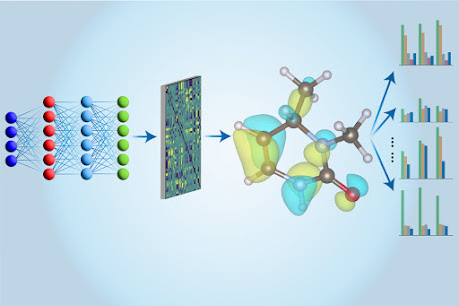
With their recently-developed neural network architecture, MIT researchers can wring more information out of electronic structure calculations. At present, most of the machine-learning models that are used to characterize molecular systems are based on density functional theory (DFT), which offers a quantum mechanical approach to determining the total energy of a molecule or crystal by looking at the electron density distribution — which is, basically, the average number of electrons located in a unit volume around each given point in space near the molecule. (Walter Kohn, who co-invented this theory 60 years ago, received a Nobel Prize in Chemistry for it in 1998.) While the method has been very successful, it has some drawbacks, according to Li: “First, the accuracy is not uniformly great. And, second, it only tells you one thing: the lowest total energy of the molecular system.” His team is now relying on a different computational chemistry technique, also derived from quant...